Insights · Topics · Chamber software
Software sold as an association solution typically assumes a club: someone joins, gets an invoice, attends an event now and then. In a chamber, no part of that sentence holds. Membership arises from admission or business registration, the contribution is assessed rather than invoiced, and continuing professional development (CPD) is a duty with consequences. This page describes the four differences that follow from this, and what they mean for selecting software — even if you end up deciding against us.
The difference
Associations and chambers are often mentioned in the same breath, and for half of the processes that is justified: persons, memberships, contributions, events, correspondence. The other half differs fundamentally — not in detail, but in logic.
These four points are the reason we do not treat chambers as a special case of an association. The shared data foundation is the same; the processes above it are not.
Scope
The arades Association Suite sits on Microsoft Dataverse, the same database Microsoft Dynamics 365 uses. Documents, accounting and tax sit in Microsoft Dynamics 365 Business Central. Every area can be implemented on its own; none of them writes into a separate database.
Persons and organizations with affiliation, status history, periods and freely definable roles on the membership. Sub-structures such as branches, local offices or chamber districts can be represented without duplicating the person.
Contribution classes with a calculation basis — flat rate, revenue-dependent, by headcount or by your own formula. The run produces the documents for every affected membership in one operation; objections are recorded and stay traceable.
Points and hours belong to the person, not to the event. The fulfilment status for the current reporting period is queryable at any time — across years and across events from different providers.
From application through verification of the preconditions to recertification, with deadline monitoring and evidence per person. The system flags expiry dates instead of leaving them in a reminder list.
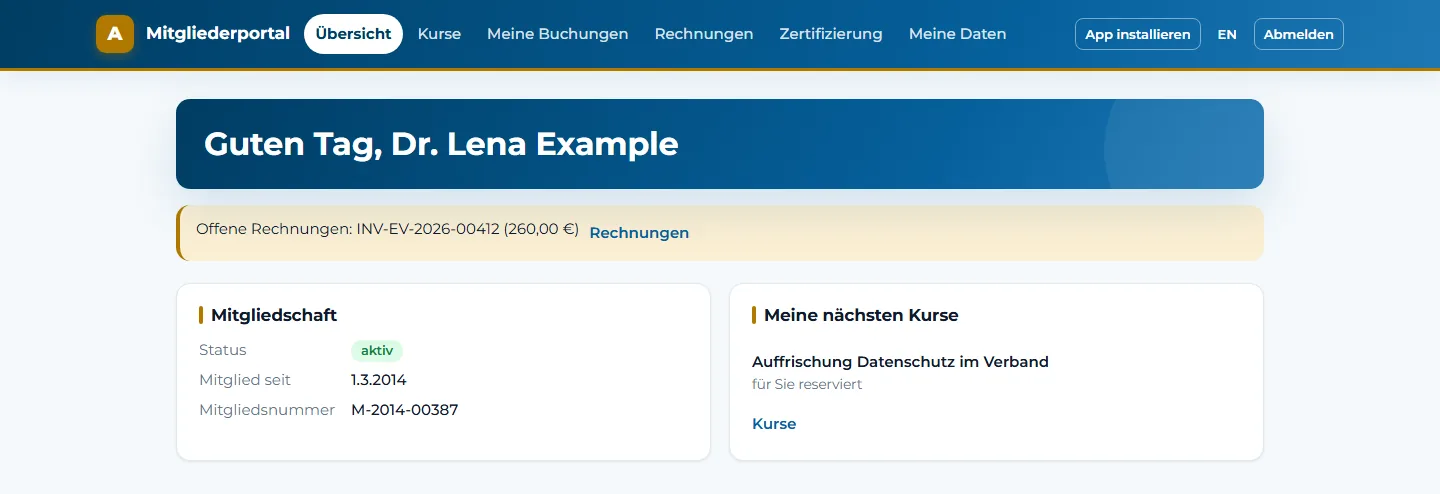
Self-service on one's own data, invoices and records, online registration for events and enquiries to the chamber office. What the member maintains themselves, the office does not have to type in.
Chamber services are managed with a catalogue, opportunities and billing — from advice through to chargeable information services. This area needs only the foundation; its link to membership management is optional.
Every message in the recipient's language, in as many languages as needed, based on 16 email templates. Your own office maintains the texts — not us, and not for a fee.
Dunning, SEPA direct debit and VAT sit in Business Central, not in a reimplementation. XRechnung and ZUGFeRD are standard capabilities there; DATEV is connected via established add-ons.
Experience with chambers
For several years, arades has supported the business processes of a German bilateral chamber of commerce abroad with a solution built specifically for it on Microsoft Dynamics 365. It supports existing administrative processes there.
Beyond that, chambers have procedures that do not otherwise occur in associations: ATA Carnets, certificates of origin, visa confirmations and attestations, each with fee calculation and approval steps. Specialist applications of this kind are neither part of the Association Suite nor a finished product of ours. Depending on the functional and technical conditions, they can be designed individually and implemented on the same platform — what that means in your case is something we clarify during requirements gathering.
And one point we state up front: electronic reporting of points to the German medical chambers is in preparation at our end and currently runs against a simulation of the interface until a test account is available. Recording the points and keeping the record per person are independent of this and in operation today. What will be available by the time you go live, we commit to before the decision.
Anonymized at the customer's request.
Selection
Six questions we recommend even if you end up deciding against us. They tell you more about a vendor than a feature list does.
Ask to be shown the path from the contribution rules to the dispatched document, including objection and traceability two years on. An invoice form with a different heading is not an assessment notice.
Ask for the fulfilment status of a single person over a multi-year period, with events from different providers. If the answer is an attendance list, the per-person account is missing.
Does the member data sit in your own environment or with the vendor? Is there a proprietary file format that makes a switch expensive? Ask for a complete export before you sign.
Contributions, dunning, VAT, SEPA, XRechnung: that is specialist software. Check whether the vendor has reimplemented it or uses an established system — and who keeps up when tax rules change.
Chamber, academy, service company: many public-law bodies need separate posting entities on a shared register of persons. Ask whether that is provided for or charged as a project.
Ask for a list with states — done, in progress, planned — and for a binding statement on what will be available by the time you go live. A demonstration shows what runs; it does not show what is missing.
Architecture
A widespread misconception in selection processes is the assumption that an ERP system should cover as much as possible. With a chamber, that usually leads to a dead end: membership, CPD accounts and certifications are not accounting objects, and in a finance system they can only be approximated with extra fields nobody wants to maintain afterwards. We draw the line differently:
The practical advantage is not the technology but the negotiating position: every one of these building blocks is a standard Microsoft product. Your data sits in your own tenant, another service provider can take the solution forward, and whatever you want to add functionally works with the Microsoft Power Platform — even without us. What this separation looks like in other use cases is described on the topic page One database for all business apps.
Related
The app behind the suites: persons, memberships with period and status, freely definable roles, contribution classes and the contribution run.
Read more →The full product page: eight areas, processes, portal, multi-entity operation and what comes next.
Read more →The same course management, a different audience: academies, universities and training providers with participants instead of members.
Read more →Professional chambers and public-law bodies have their own eligibility logic — checking it pays off before any procurement.
Read more →Why Dataverse as a shared data foundation is the alternative to four siloed systems — with the cost picture and the limits.
Read more →Business Central and its larger siblings compared: what each system carries, and where the sensible boundary lies.
Read more →Keeping existing systems and connecting them: APIs, connectors and the question of what really has to be migrated.
Read more →Frequent questions
Four things, and all four have consequences for the software. First, membership in a chamber does not arise from joining but from admission, appointment or business registration — there is no acquisition funnel, there is an assignment that has to be correct. Second, the contribution is not an invoice amount but an assessment under the contribution rules, issued as a formal notice against which an objection can be lodged. Third, a CPD record has a legal consequence, not merely informational value: it is kept per person over years and submitted to the chamber. Fourth, a chamber reports to a supervisory body and compiles statistics, which forces traceability and data history. Software that only knows joining, invoicing and attendance confirmation covers none of these four as a chamber needs them.
Contribution assessment runs through contribution classes with a calculation basis — flat rate, revenue-dependent, by headcount or by your own formula — and from that produces the run for every affected membership. The document itself is created in Microsoft Dynamics 365 Business Central, which also holds dunning, SEPA direct debit and VAT. What the chamber sends out is generated from a template your own office maintains; the notice of legal remedy and any further wording are therefore part of the template and not built into the program. An objection that is lodged is recorded on the membership and on the document, so the history stays traceable years later.
Points and hours belong to the person, not to the event. Every attendance posts to that person's account, with period, type of evidence and source. From that, the fulfilment status for the current reporting period is available at any time, across several years and across events from different providers. Missing evidence surfaces before the period ends, because the status is queryable per person and does not have to be reconstructed from attendance lists. Attendance certificates are produced from the same record, without a second list.
Electronic reporting of points to the German medical chambers is in preparation and not yet in use. It currently runs against a simulation of the interface until a test account from the responsible chamber is available. What will be available by the time you go live, we commit to before the decision, not after. Recording the points themselves, keeping the record per person and issuing attendance certificates are independent of this and in operation today.
Yes, and with chambers that is the rule rather than the exception: the chamber itself, an affiliated academy and often a service or holding company. Separate posting entities in Business Central sit alongside one shared register of persons in Microsoft Dataverse — a person is created once and can carry documents in several entities. This is provided for and not a bespoke build; the question of what a second legal entity costs is worth asking of every vendor.
No. Procedures such as ATA Carnets, certificates of origin, visa confirmations or attestations — each with fee calculation and approval steps — are neither part of the Association Suite nor a finished product of ours. We have implemented procedures of this kind for a German bilateral chamber of commerce abroad, which has been running them for several years, and depending on the functional and technical conditions we can design them individually on the same platform. What that means in your case is something we clarify during requirements gathering.
60-min demonstration · free
An hour is enough to show the contribution run, the CPD account and the portal against your own cases — and to say what of that runs today and what does not. Bring management, contributions and IT; the questions differ for all three roles.