Solutions · Apps · Course management
The same app runs at an association offering CPD to its members and at an education institute selling open courses. What differs is the price that applies and the body the record is produced for; the points account stays with the person in both cases. This page describes the app on its own, with its boundary with accounting and with what it explicitly is not.
What the app holds
A frequent mistake when rebuilding this is to keep course and session in one record. By the second run of the same course the description exists twice — and from then on nobody keeps both in step.
The template holds description, learning objectives, duration and participant limits, and is maintained in one place. The session holds date, location, trainer and price. A course can be scheduled as often as you like without copying the description.
With a status from registration through confirmation and attendance to the certificate. Someone who attended the same course three times has three attendances and one person — a field on the person cannot hold that.
With trainer assignment, room booking and a materials list. Double bookings of a room or a trainer are detected before saving, not on the day. Online sessions are linked to the Microsoft Teams meeting.
Per person, across multi-year reporting periods, including events from other providers that are only recorded after the fact. The fulfilment status is queryable at any time and does not have to be reconstructed from attendance lists; utilization and CPD status can be analyzed with Microsoft Power BI.
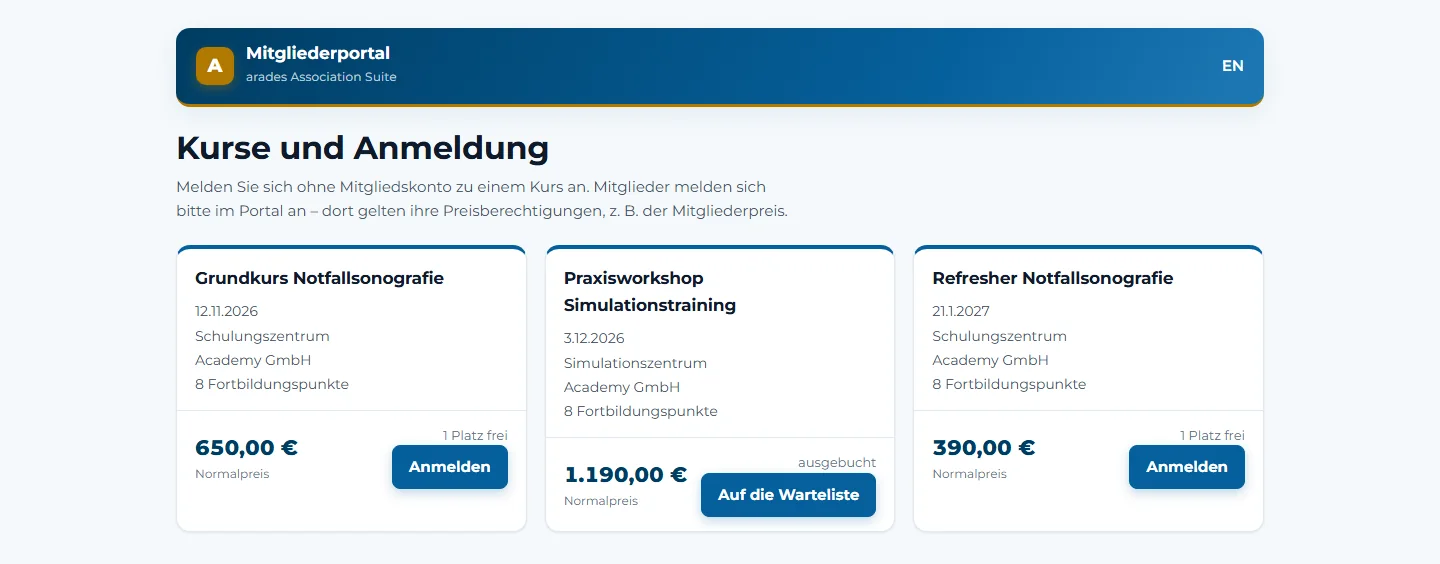
Via portal or website, with confirmation, a reminder before the session and cancellation against a stored deadline. What the member or participant enters themselves, the office does not have to re-type.
From the attendance record, with placeholders for name, course, date and signature. Sent by email or printed in bulk — from the same record as the points account, without a second list.
Automation
When a place frees up, the offer goes to the next person with a confirmation deadline; once the deadline passes, the person after them moves up. Nobody has to work through a list, and no place stays empty because the cancellation came on a Friday evening.
With time, location or Teams link, and the notes held against the course template. In the language held against the person.
When a reporting period is running out and points are missing, that surfaces while there is still time. It is the difference between a system of record and a list.
The boundary
The line runs exactly where a receivable becomes a document. Everything before it belongs to the app, everything after it to Microsoft Dynamics 365 Business Central:
The reason is the same as with membership management: course and CPD rules change rarely, while tax law changes constantly. When tax rules change, Microsoft should be the one to follow, not us — and you should not have to wait on our release plan because a tax rate moved.
Where the app sits
Course management is not rebuilt per industry. What differs is the setting around it — memberships on one side, open courses on the other.
CPD for members: the points stay with the person, the member price applies automatically through the membership, and the CPD record is produced for the chamber.
To the solution →Open courses for participants without a membership: registration via the website, billing per person or per client, a certificate at the end.
To the solution →Scope
With courses especially, expectations diverge widely. This list saves you the demonstration in which it turns out two different things were meant.
Frequent questions
A learning management system holds the learning material: modules, videos, assignments, tests, progress. This app holds the organization around it: who registered, when the session takes place, who actually attended, what gets billed and what CPD record comes out of it. Together they give the full picture, and the two can be connected — but they are different things. Anyone looking for an LMS is looking for something other than this app; anyone organizing, billing and certifying classroom and online sessions is looking for exactly this one.
Points and hours belong to the person, not to the session. Every attendance posts to that person's account, with period, type of evidence and source — including where the event came from a different provider and is only being recorded after the fact. From that, the fulfilment status for the current reporting period is available at any time. Missing evidence surfaces before the period ends, because the status is queryable per person and does not have to be reconstructed from attendance lists.
The app holds courses, sessions, attendances, accounts and certificates. It determines who has to pay what — course fee, member price, cancellation after the deadline. What becomes a document out of that is created in Microsoft Dynamics 365 Business Central: invoice, VAT, payment and dunning. The boundary is the same as with membership management and drawn for the same reason: course and CPD rules change rarely, while tax law changes constantly — and when tax rules change, Microsoft should be the one to follow, not us.
Yes. It needs persons, not memberships. The shared basis is the register of persons in Microsoft Dataverse, not the membership logic. Where both run together — an association with its own academy — the record can hang on the membership and the member price can apply automatically. Where there are no members — an education institute with open courses — everything hangs on the person. Both cases are provided for, and the second is not a special case of the first.
The data sits in your own Microsoft tenant, in Microsoft Dataverse. That is the same database Microsoft Dynamics 365 uses — not a proprietary file format you would later have to migrate out of. A full export is possible at any time, and another service provider can take the solution forward, because every building block underneath is a standard Microsoft product.
Related
The second app on the same level: persons, memberships with period and status, roles, contribution classes and the contribution run.
Read more →Why a CPD record in a chamber carries a legal consequence and is not merely an attendance confirmation.
Read more →A1 free of charge, A3 and A5 at faculty or student rates — with a charitable sponsor structure, the non-profit programme on top.
Read more →60-min demonstration · free
An hour is enough to show the course template, the session, registration and the points account against your own courses — and to say which parts are configuration and which are development. Bring your office, your course administration and your IT.